


Introduction
In the age of rapid technological advancement, crime no longer hides in the shadows—it hides in data, devices, and digital trails. Enter the forensic gadgeteer: a new breed of crime solver who merges technical expertise with investigative skill to uncover the truth buried in bytes and bandwidth.
A forensic gadgeteer is a specialist who uses advanced technological tools and digital forensic methods to assist in criminal investigations. From extracting data off damaged devices to decoding encrypted messages, these tech-savvy professionals operate at the intersection of law enforcement and cutting-edge technology.
As crimes become increasingly digital—ranging from cyberattacks and identity theft to data breaches and high-tech espionage—the role of the forensic gadgeteer is more crucial than ever. Law enforcement agencies, private firms, and even global intelligence networks now rely on their skills to trace digital footprints, recover hidden evidence, and bring criminals to justice.
Technology has transformed crime-solving dramatically. Traditional methods like fingerprinting and eyewitness accounts are now complemented by digital forensics, network analysis, and real-time surveillance. In this new era, forensic gadgeteers are not just support staff—they’re often the key to cracking a case.
What Is a Forensic Gadgeteer?
A forensic gadgeteer is a highly skilled investigator who specializes in using advanced technological tools and digital forensics techniques to uncover evidence in criminal cases. Think of them as the modern-day detective—armed not with a magnifying glass, but with data recovery software, decryption tools, and a deep understanding of how digital devices store and transmit information.
Unlike traditional forensic experts who may focus on physical evidence like blood, hair, or fingerprints, forensic gadgeteers work primarily in the digital realm. They analyze smartphones, laptops, servers, cloud storage, and even IoT (Internet of Things) devices to retrieve hidden, deleted, or encrypted data that could serve as crucial evidence in a case.
Their work often involves:
- Recovering deleted files and communications
- Tracing IP addresses and online activity
- Analyzing metadata to reconstruct digital timelines
- Extracting evidence from damaged or encrypted devices
- Identifying sources of cyberattacks or unauthorized data access
What sets a forensic gadgeteer apart is not just their technical skill, but their ability to bridge the gap between complex technology and legal procedures. They must ensure that digital evidence is collected, preserved, and presented in a way that holds up in court. This often means working closely with law enforcement, legal teams, and cybersecurity experts.
In a world where digital evidence can make or break a case, the forensic gadgeteer plays a vital role—uncovering truths that hide in plain sight, buried within lines of code and digital footprints.
Essential Tools of a Forensic Gadgeteer
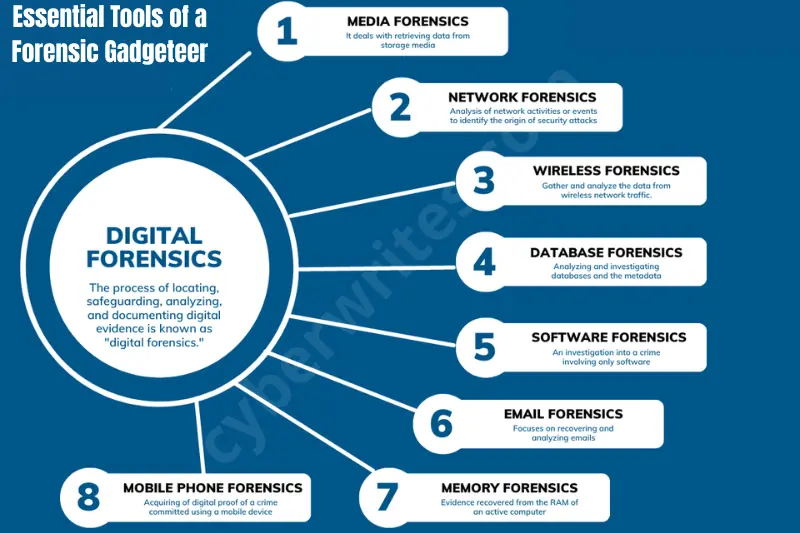
Behind every successful forensic gadgeteer is a toolkit filled with powerful, high-tech gear designed to uncover digital evidence with precision. These tools are essential for identifying, preserving, analyzing, and presenting data that can be used in criminal investigations and legal proceedings.
Here are some of the most important forensic tools and gadgets used in the field today:
Mobile Device Forensics Tools
Examples: Cellebrite, Oxygen Forensic Detective
These tools allow forensic gadgeteers to extract data from smartphones and tablets — even if it has been deleted or encrypted. They can access call logs, messages, app data, photos, and GPS locations, which often play a critical role in solving crimes involving mobile communication.
Related keywords used: mobile forensic tools, digital evidence collection
Disk Imaging and Cloning Software
Examples: FTK Imager, EnCase
Forensic gadgeteers use these tools to create exact, bit-by-bit copies of hard drives or storage devices. This ensures the original evidence remains untouched while analysis is conducted on the copy — a key requirement in legal investigations.
Write Blockers
Function: Prevent any modification to the source device during data collection
These hardware devices allow read-only access to storage media, ensuring the integrity of the original data. Using a write blocker is considered a best practice in digital evidence handling, as it prevents accidental or intentional changes to the evidence.
Network Forensic Tools
Examples: Wireshark, Xplico
These tools monitor and capture network traffic in real-time or analyze previously recorded sessions. They are vital for uncovering cyberattacks, unauthorized access, or data exfiltration activities.
Related keyword: network sniffers
Password Cracking and Decryption Tools
Examples: Hashcat, John the Ripper
When data is encrypted or protected by passwords, forensic gadgeteers use ethical password recovery tools to gain lawful access. These tools can help recover encrypted emails, protected documents, or locked user accounts — often with proper legal clearance.
Data Recovery Software
Examples: R-Studio, Recuva, PhotoRec
These tools assist in recovering deleted, corrupted, or formatted data from various digital storage devices. They are essential in cases where suspects attempt to wipe digital evidence from drives, memory cards, or USB devices.
Log and Metadata Analyzers
Function: Reconstruct digital activity timelines
Metadata and log files can reveal when and how a file was created, accessed, or altered. By analyzing this data, forensic gadgeteers can build detailed timelines of a suspect’s actions, file usage, or attempts to hide their digital footprint.
Cloud Forensics Tools
Examples: Magnet AXIOM Cloud, Elcomsoft Cloud Explorer
With more data stored online than ever before, cloud forensics tools help forensic gadgeteers extract and analyze evidence from services like Google Drive, Dropbox, iCloud, and more. Access is always obtained through legal channels, ensuring compliance with privacy laws and chain of custody.
These tools represent the core of a forensic gadgeteer’s capabilities. As digital crimes grow more complex, so do the technologies designed to investigate them. Whether it’s recovering deleted data, tracking network intrusions, or analyzing cloud storage, the modern forensic gadgeteer is equipped to meet the challenges of a digital world head-on.
The Role of a Forensic Gadgeteer in Crime Investigations
In today’s digitally connected world, nearly every crime leaves a digital footprint. Whether it’s a cyberattack, a financial fraud case, or even a physical crime where suspects use phones or online communication, the forensic gadgeteer plays a critical role in uncovering the digital evidence that connects the dots.
Bridging Technology and Investigation
The forensic gadgeteer serves as a bridge between law enforcement and technology. While traditional detectives gather physical evidence, forensic gadgeteers analyze the digital trail — emails, text messages, social media activity, GPS data, browser histories, and more. This digital data often provides timelines, connections between suspects, or even direct evidence of criminal activity.
Key Responsibilities in an Investigation:
- Identifying Digital Evidence: Determining which devices or data sources might contain useful evidence.
- Data Acquisition: Using specialized tools to extract data from computers, mobile devices, servers, and cloud platforms.
- Data Preservation: Ensuring all evidence is collected without alteration and maintaining a proper chain of custody.
- Analysis and Interpretation: Examining files, metadata, communications, and online activity to draw meaningful conclusions.
- Reporting and Testimony: Preparing detailed forensic reports and often testifying in court as expert witnesses to explain their findings.
Real-World Scenarios
- Cybercrime Investigations
Forensic gadgeteers are often called in to track down hackers, trace ransomware attacks, or analyze phishing campaigns. They work with cybersecurity teams to find the entry points, determine what data was accessed, and help identify suspects. - White-Collar Crime
In corporate fraud or embezzlement cases, gadgeteers might examine financial records, trace emails, or uncover hidden data manipulated within software systems or spreadsheets. - Violent Crime Cases
Even in traditional crimes like homicide or assault, digital evidence can be pivotal. Phone records, text messages, GPS data, or even surveillance footage can help place a suspect at the scene or establish motive. - Missing Persons and Abductions
Investigators use gadgeteers to analyze the victim’s and suspect’s digital lives—tracking messages, last known locations, and online activity for leads.
Collaboration with Law Enforcement
Forensic gadgeteers rarely work in isolation. They are part of multi-disciplinary investigative teams that include detectives, prosecutors, cybersecurity professionals, and legal experts. Their findings often help guide the direction of an investigation or strengthen the case with solid, court-admissible digital evidence.
The role of the forensic gadgeteer is no longer optional—it’s essential. As digital activity becomes more intertwined with our daily lives, these experts are the ones ensuring that even the most elusive data doesn’t escape the pursuit of justice.
How Forensic Gadgeteers Are Changing Modern Forensics
The landscape of criminal investigation has undergone a massive transformation in recent years—and at the center of that change is the forensic gadgeteer. By integrating advanced technology with investigative processes, forensic gadgeteers are redefining how evidence is collected, analyzed, and used in solving crimes.
From Physical Clues to Digital Footprints
Traditional forensic science focused primarily on physical evidence—fingerprints, blood samples, ballistics, and other tangible clues. While still important, these are now just one piece of the puzzle. In today’s world, where nearly every activity leaves a digital trail, digital evidence can often reveal far more than physical evidence alone.
Forensic gadgeteers are trained to follow these digital footprints. Whether it’s tracing the source of an anonymous message, uncovering hidden data on a seized laptop, or reconstructing events based on a smartphone’s GPS history, they bring new dimensions to forensic work.
Increased Speed and Precision
One of the biggest impacts of forensic gadgeteers is the speed at which investigations can now progress. Tools that once took days to produce results can now analyze terabytes of data in hours. This efficiency can be the difference between solving a case in days instead of weeks—or preventing future crimes altogether.
In addition, digital forensics allows for greater accuracy and objectivity. Log files, timestamps, and metadata offer hard evidence that is difficult to dispute, reducing reliance on subjective interpretations.
Expanded Investigative Scope
With their expertise, forensic gadgeteers have made it possible to investigate cases that would have been nearly impossible a decade ago. These include:
- Cybercrimes like hacking, identity theft, and ransomware
- Cross-border digital fraud and international data breaches
- Insider threats and internal data leaks in corporations
- Online harassment, stalking, and digital abuse
Thanks to the tools and methods they use, investigators can now access data stored in remote servers, encrypted devices, and cloud platforms—evidence that was once out of reach.
Shaping the Future of Law Enforcement
The work of forensic gadgeteers is influencing how police departments and federal agencies are staffed, trained, and equipped. Law enforcement agencies are now investing more in digital crime labs, hiring cyber forensic specialists, and providing cross-training for officers to understand basic digital evidence protocols.
Moreover, their findings often become key components of legal arguments, influencing everything from arrest warrants to courtroom strategies.
In short, forensic gadgeteers are not just adapting to the digital age—they are shaping the future of criminal investigations. Their role represents a fundamental shift in how justice is pursued in an increasingly connected world.
Skills & Education Required
Becoming a successful forensic gadgeteer requires a blend of technical knowledge, investigative skills, and legal understanding. Because they operate at the intersection of technology and law enforcement, forensic gadgeteers must be well-versed in both areas to effectively gather and analyze digital evidence that can stand up in court.
Key Technical Skills
- Cybersecurity Fundamentals: Understanding how networks operate, common vulnerabilities, and methods hackers use to breach systems.
- Digital Forensics Techniques: Expertise in recovering, preserving, and analyzing digital evidence from computers, mobile devices, and cloud services.
- Data Analysis and Interpretation: Ability to examine logs, metadata, and digital artifacts to reconstruct timelines and identify patterns.
- Programming and Scripting: Knowledge of languages such as Python, Bash, or PowerShell to automate tasks, write forensic scripts, or analyze code.
- Cryptography and Encryption: Understanding encryption methods and how to approach encrypted data legally and ethically.
Soft Skills
- Attention to Detail: Even minor discrepancies or overlooked data points can be critical in investigations.
- Critical Thinking and Problem Solving: Ability to think analytically to connect seemingly unrelated pieces of digital evidence.
- Communication Skills: Forensic gadgeteers must clearly document their findings and often testify in court, explaining complex technical details in an understandable way.
- Ethical Judgment: Handling sensitive data responsibly while respecting privacy laws and maintaining professional integrity.
Educational Pathways
- Degrees: Many forensic gadgeteers hold degrees in computer science, cybersecurity, digital forensics, or information technology.
- Certifications: Industry-recognized certifications can significantly enhance credibility and skills. Common certifications include:
- Certified Computer Forensics Examiner (CCFE)
- Certified Forensic Computer Examiner (CFCE)
- GIAC Certified Forensic Analyst (GCFA)
- EnCase Certified Examiner (EnCE)
Training Programs: Hands-on training through boot camps, workshops, or internships is essential for practical experience.
Continuous Learning
Given how fast technology evolves, forensic gadgeteers must commit to ongoing education. Staying updated on the latest forensic tools, hacking techniques, and legal requirements is crucial for remaining effective and compliant.
Famous Cases Solved by Forensic Gadgeteers
The rise of the forensic gadgeteer has played a pivotal role in solving some of the most complex and high-profile cases in recent history. By leveraging cutting-edge technology and digital forensics, these experts have helped bring justice where traditional methods alone might have fallen short.
The Silk Road Investigation
One of the most famous cases involving digital forensics was the takedown of the Silk Road, an online black market notorious for illegal drug sales and other illicit activities. Forensic gadgeteers helped trace the digital footprints left by the site’s founder, Ross Ulbricht, by analyzing server logs, cryptocurrency transactions, and internet activity. Their work was crucial in building the case that led to his arrest and conviction.
The BTK Killer Case
Decades after the BTK (Bind, Torture, Kill) serial killer went dormant, forensic gadgeteers used digital analysis to link the killer to the crimes. Investigators examined metadata embedded in a floppy disk sent to the police, which eventually led to Dennis Rader’s arrest. This case highlighted how even older digital evidence can be vital when properly analyzed.
The Sony Pictures Hack
In 2014, Sony Pictures experienced a major cyberattack attributed to North Korean hackers. Forensic gadgeteers and cybersecurity experts worked together to analyze malware, track network intrusions, and uncover the methods used by attackers. Their investigation helped attribute the attack and informed the company’s security overhaul.
The Boston Marathon Bombing
In the aftermath of the 2013 Boston Marathon bombing, forensic gadgeteers assisted law enforcement by analyzing surveillance footage, mobile phone data, and social media activity to identify the suspects quickly. Digital forensics played a key role in piecing together the timeline and movements of the attackers.
These cases demonstrate the critical role forensic gadgeteers play in modern investigations. Their expertise in uncovering and interpreting digital evidence often turns the tide in solving crimes that span from cyberattacks to violent offenses.
Future of the Forensic Gadgeteer
As technology continues to evolve at an unprecedented pace, so too does the role of the forensic gadgeteer. The future promises both exciting advancements and new challenges in digital forensics, making this field one of the most dynamic and essential in law enforcement and cybersecurity.
Integration of Artificial Intelligence and Machine Learning
Artificial intelligence (AI) and machine learning are set to revolutionize digital forensics. These technologies can automate the analysis of vast amounts of data, identify patterns and anomalies faster than humans, and even predict potential cyber threats before they occur. Forensic gadgeteers will increasingly rely on AI-powered tools to enhance accuracy and efficiency.
Expansion into Emerging Technologies
With the rise of the Internet of Things (IoT), wearable devices, autonomous vehicles, and blockchain, forensic gadgeteers will need to develop expertise in new types of digital evidence. Each of these technologies presents unique forensic challenges, from analyzing data in decentralized ledgers to extracting information from smart home devices.
Enhanced Cybersecurity Collaboration
As cyber threats grow more sophisticated, forensic gadgeteers will work even more closely with cybersecurity professionals, intelligence agencies, and private sector experts. This collaboration will be crucial for responding to large-scale cyberattacks, protecting critical infrastructure, and combating international cybercrime.
Ethical and Privacy Considerations
The increased use of digital surveillance and forensic analysis raises important ethical questions. Forensic gadgeteers will have to balance the need for effective crime-solving with respecting privacy rights and ensuring data protection. Developing clear policies and adhering to legal standards will be more critical than ever.
Growing Demand and Career Opportunities
With the digital transformation touching nearly every industry, the demand for skilled forensic gadgeteers is expected to rise sharply. Governments, corporations, and law enforcement agencies worldwide will seek these experts to safeguard digital assets and support investigations.
These cases demonstrate the critical role forensic gadgeteers play in modern investigations. Their expertise in uncovering and interpreting digital evidence often turns the tide in solving crimes that span from cyberattacks to violent offenses.
Future of the Forensic Gadgeteer
As technology continues to evolve at an unprecedented pace, so too does the role of the forensic gadgeteer. The future promises both exciting advancements and new challenges in digital forensics, making this field one of the most dynamic and essential in law enforcement and cybersecurity.
Integration of Artificial Intelligence and Machine Learning
Artificial intelligence (AI) and machine learning are set to revolutionize digital forensics. These technologies can automate the analysis of vast amounts of data, identify patterns and anomalies faster than humans, and even predict potential cyber threats before they occur. Forensic gadgeteers will increasingly rely on AI-powered tools to enhance accuracy and efficiency.
Expansion into Emerging Technologies
With the rise of the Internet of Things (IoT), wearable devices, autonomous vehicles, and blockchain, forensic gadgeteers will need to develop expertise in new types of digital evidence. Each of these technologies presents unique forensic challenges, from analyzing data in decentralized ledgers to extracting information from smart home devices.
Enhanced Cybersecurity Collaboration
As cyber threats grow more sophisticated, forensic gadgeteers will work even more closely with cybersecurity professionals, intelligence agencies, and private sector experts. This collaboration will be crucial for responding to large-scale cyberattacks, protecting critical infrastructure, and combating international cybercrime.
Ethical and Privacy Considerations
The increased use of digital surveillance and forensic analysis raises important ethical questions. Forensic gadgeteers will have to balance the need for effective crime-solving with respecting privacy rights and ensuring data protection. Developing clear policies and adhering to legal standards will be more critical than ever.
Growing Demand and Career Opportunities
With the digital transformation touching nearly every industry, the demand for skilled forensic gadgeteers is expected to rise sharply. Governments, corporations, and law enforcement agencies worldwide will seek these experts to safeguard digital assets and support investigations.
In conclusion, the forensic gadgeteer is not just a product of modern technology—they are its future custodians. As crimes become more complex and digital in nature, their role will be indispensable in ensuring justice in the digital age.
